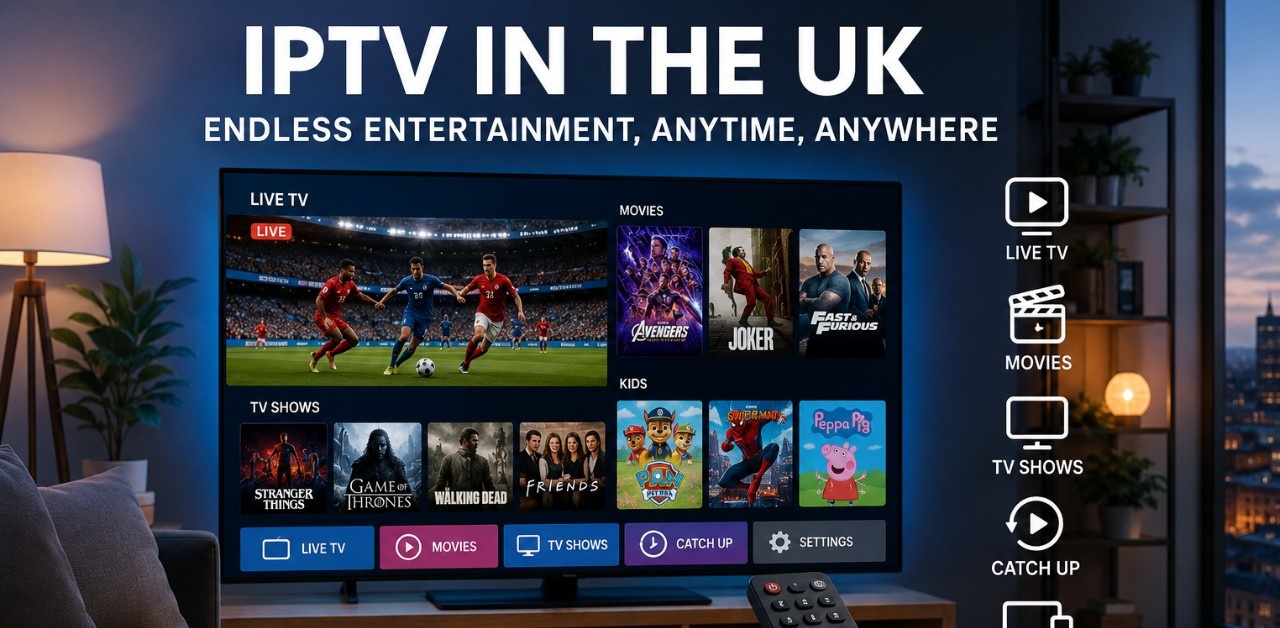
Unlock Endless Entertainment: IPTV in the UK Explained
Internet Protocol Television (IPTV) delivers television video using IP networks. Instead of relying exclusively on a satellite dish or traditional aerial feed, a viewer receives streams through an internet-capable device and an appropriate player or service application.
If you are new to the terminology, see our beginner’s explanation of IPTV.
The phrase “IPTV in the UK” covers several different experiences. A broadcaster's own app, a licensed live TV subscription, an on-demand streaming catalogue and a playlist-driven player are not interchangeable services. Understanding the difference helps explain why some viewers see a familiar programme guide while others open individual titles or use a playlist.
This companion article examines how live TV, video on demand and catch-up are delivered, how playback buffering works, and which technical limits matter. If you are completely new to the terminology or need first-time setup steps, start with the beginner's guide linked above.
LIVE TV, VOD AND CATCH-UP: DELIVERY FORMATS
1. Live television: the service distributes a programme while it is being broadcast. The viewer selects a live channel, and the player receives video data as it is delivered. Live internet streaming can lag behind aerial or satellite broadcasts; the delay varies with encoding, network conditions, the player and its buffer.
2. Video on demand (VOD): the viewer chooses an available programme or film and starts playback at a time that suits them. Catalogues, regions, expiry dates and viewing rights differ by provider.
3. Catch-up and time-shifted television: where offered, viewers can play a programme after its original broadcast. The replay window and which shows are eligible depend on the broadcaster and licence arrangements. Recording features, when available, are separate from catch-up.
A service may offer one, two or all three formats. Never assume that the words “IPTV subscription” guarantee VOD, recording, catch-up or a particular channel.
HOW PLAYBACK WORKS: STREAM DELIVERY AND BUFFERING
A typical authorised streaming session includes several components:
A content source with rights to distribute the programme.
A delivery system that encodes and serves video, often in short segments. Where supported, adaptive streaming offers different bitrate versions so a compatible player can adjust picture quality as connection conditions change.
A network connection between the service and the viewer.
An app or compatible player that receives the stream and displays video and audio.
When a viewer starts playback, the application requests an available stream and begins filling a small buffer. If the connection slows, a player may switch to a lower video quality where the service supports adaptive streaming. If the network becomes unstable or the source is unavailable, playback can pause regardless of the price paid for the subscription.
This is why evaluating a real service involves more than looking at its advertised resolution.
HOW IPTV DIFFERS FROM AERIAL, SATELLITE AND TRADITIONAL CABLE
With aerial or satellite distribution, programmes reach the receiver through broadcast infrastructure. The core delivery path typically does not depend on the household's broadband speed. Internet-delivered TV depends more directly on the viewer's network, the service's servers and any limits on the account.
For the main practical differences with cable services, review the IPTV versus cable TV comparison.
Internet delivery can make it easier to watch on phones and tablets, browse an on-demand library and resume supported programmes across devices. Traditional broadcast options may be a better fit where broadband is unreliable or where a viewer needs a particular channel with established rights and regional coverage.
Many households use a combination: terrestrial or satellite television for some programming, broadcaster apps for catch-up and licensed streaming services for other content. There is no need to treat the options as mutually exclusive.
WHAT EQUIPMENT DO YOU NEED?
For most internet-delivered services, the essentials are a stable connection, a compatible device, a suitable app, and an account or authorisation where required. Smart TVs, streaming sticks, phones, tablets and computers can all support some IPTV services, but app availability depends on the device platform and model.
Do not assume that a playlist is the same thing as a subscription. A player can organise and display video streams, but it does not grant content rights or make an unlicensed stream lawful.
See the existing device guides:
https://streamiptvuk.it.com/installation-guides
https://streamiptvuk.it.com/blog/how-to-set-up-iptv-on-samsung-tv
https://streamiptvuk.it.com/blog/iptvuk-for-iphone-and-ipad-complete-setup-guide
THE PRACTICAL LIMITATIONS PEOPLE OFTEN MISS
Broadband and Wi-Fi: Speed is only one factor. Signal stability, latency, congestion and other devices in the home can affect playback. A wired connection can help diagnose local Wi-Fi problems.
Regional availability: A catalogue available in one country may be unavailable in another because distribution rights differ.
Device support: Some TV platforms allow only applications distributed through their own app stores. An app working on an Android phone does not prove it is compatible with a particular smart TV.
Account limits: Multi-device compatibility is not the same as permission to stream concurrently on unlimited screens.
Service variation: Programme guides, subtitles, replay windows, parental controls and audio options vary. Check what is actually included, rather than inferring those features from “HD” or “4K” claims.
Reliability and support: Any internet-based service can experience outages. Transparent status information and realistic technical support are useful.
WHEN IS IPTV LEGAL IN THE UK?
IPTV is a technology, not a legal classification of every service that uses it. What matters is whether the provider and viewer have permission to access and distribute the content. Official broadcaster apps and authorised streaming services can lawfully deliver programmes over the internet. Accessing copyrighted films, subscription television or sports without the appropriate permission can be unlawful.
The UK Intellectual Property Office warns specifically about illicit streaming devices and unauthorised content. Before paying for a service, assess the offered content and check the provider's rights rather than relying on a price or a claim of being “premium”.
Official guidance: https://www.gov.uk/government/publications/illicit-streaming-devices/illicit-streaming-devices
Related site guide: https://streamiptvuk.it.com/blog/is-iptv-legal-in-the-uk-complete-guide-2026
HOW TO DECIDE WHETHER INTERNET TV IS A GOOD FIT
Begin with a shortlist of the programmes you watch, the devices you own and the connection you actually have. If a provider offers a permitted trial, use it to check image quality, navigation, support and advertised functions. Compare the total subscription cost and any renewal or connection limits before buying.
A helpful comparison is based on verified content access, device compatibility, real viewing quality and clear terms. The highest channel count alone cannot establish which service suits you.
For the current site's offer details:
https://streamiptvuk.it.com/trial
https://streamiptvuk.it.com/pricing
FREQUENTLY ASKED QUESTIONS
Is IPTV the same as Netflix or BBC iPlayer?
They all use internet delivery in some form, but the term IPTV is broader. Different services specialise in live channels, on-demand programmes or broadcaster catch-up, and each supplies different content and account features.
Do I need a special IPTV box?
Not necessarily. It depends on whether the chosen service has a supported app for your existing television, phone or computer. Some viewers use an external streaming device because the TV's app selection is limited.
Can IPTV replace satellite television?
It may replace some viewing habits, but content rights, available channels, broadband reliability and desired features matter. Compare what you actually watch before cancelling an existing package.
Does IPTV always offer 4K or catch-up?
No. These capabilities depend on the programme, provider, device and connection. Confirm them directly.
FINAL TAKEAWAY
IPTV is a flexible delivery method whose value depends on the particular authorised service and the viewer's circumstances. Start by understanding live TV, VOD and catch-up as different features, then assess licences, devices, broadband and support before deciding.
